
The Clear Lake Food Chain
Silent SpringThis flow follows DDD from lake water into prey and predators, ending in the collapse of the grebe colony.
increasing Bearing strength in each event
 decreasing
Bearing strength in each eventdecreasingThe Gnat Problem

A Lake Annoyance
A Local Target
At Clear Lake, California, dense populations of a non-biting gnat annoyed residents and visitors. Earlier attempts to control it had achieved little success.
A New Chemical Solution
DDD appeared to offer an alternative that seemed less dangerous to fish than other available choices. The perceived modesty of the problem contrasted with the ecological scale of treating an entire lake.
The First Treatment

A Diluted Application
Planned Control
Officials surveyed the lake and applied DDD at a great dilution. The initial reduction in gnats suggested that the treatment had succeeded without an obvious immediate disaster.
A Hidden Destination
The chemical did not simply vanish after entering the water. Its movement into living organisms would make the apparent dilution a poor measure of the dose eventually received by predators.
Grebes Begin to Die

The First Warning
Deaths on the Lake
After treatment was repeated in 1954, western grebes began dying during the following winter. More than a hundred dead birds were reported.
A Question of Cause
No infectious disease explained the deaths. Analysis of fatty tissue instead revealed a heavy DDD burden, pointing investigators toward accumulated contamination rather than an acute outbreak.
Predators Magnify the Dose
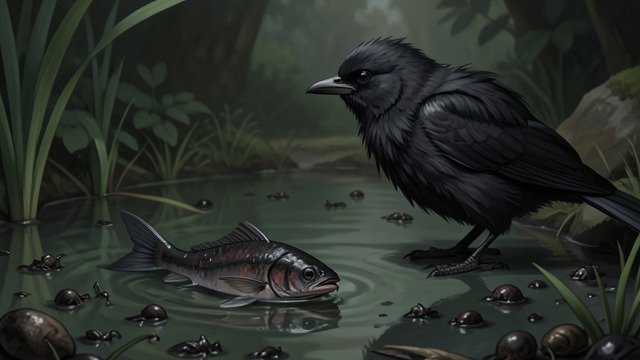
Poison Through the Food Web
Concentration by Feeding
Plankton contained more DDD than the water, and fish contained far higher concentrations. Carnivorous fish accumulated especially large amounts after eating smaller contaminated organisms.
Grebes as Fish-Eaters
Grebes fed at the top of this chain and accumulated extraordinary residues. The lake’s ecology transformed an application measured in tiny concentrations into a severe burden for its predators.
The Colony Fades

Breeding Ends
A Shrinking Population
The grebe colony fell from more than a thousand breeding pairs before treatment to about thirty pairs in 1960. No young grebes had been observed on the lake since the last application.
The Human Question
Carson asks what contaminated fish could mean for people eating from the lake. Ending DDD use became a minimum precaution, while the grebes’ decline exposed the danger of solving a small nuisance with a persistent poison.
Before 1949
1949
Winter 1954–1955
After the 1957 treatment
By 1960
